To view info, flags, and options for the build command, run email help build.
CLI
The Command Line Interface and developer tooling for JSX email
pnpm
aube
bun
npm
yarn
pnpm add jsx-emailNearly all installations of this package will want it installed into devDependencies so please make sure to add the -D flag.
Usage
Installing this package will add an email binary, which will be available to pnpm exec, npx, and yarn.
Invoking the CLI without parameters or flags will produce help information in the console. From there, all of the functions of the CLI can be viewed, along with any applicable parameters and flags:
→ pnpm exec email

jsx-email v0.0.0

A CLI for working with Email Templates made with jsx-email

Usage
  $ email [...options]

Commands
  build       <template file or dir path>
  check       <template file path>
  create      <template name>
  help        [<command>]
  preview     <template dir path>

Options
  --help      Displays this message
  --version   Displays the current jsx-email version

Examples
  $ email
  $ email --help
  $ email build ./src/templates/Invite.tsx
  $ email create invite
  $ email preview ./src/templates
Build
Tips
The build command compiles and renders an email template to HTML for use with an email provider. The command takes a directory or single file as input:
$ cd ~/code/email-app
$ email build ./emails
Or for a single file:
$ cd ~/code/email-app
$ email build ./emails/Batman.tsx
To render using the sample props you export from a template file, pass the --use-preview-props flag. When set, email build will use the previewProps export (if present) instead of --props.
Check
Tips
To view info, flags, and options for the check command, run email help check.
jsx-email can run a client compatibility check on any template, comparing it to the compatibility tables from `caniuse.com and display any email client incompatibility issues. This check is incredibly helpful in diagnosing and debugging display issues between multiple email clients.
$ email check ./emails/Batman.tsxTo check templates using their exported previewProps, pass the --use-preview-props flag so the check runs against the same sample data as your previews and builds.
To limit compatibility checks to specific email clients, pass --email-clients with a comma-separated list of caniemail client names or globs:
$ email check ./emails/Batman.tsx --email-clients gmail.*,outlook.*Default check clients can also be configured in jsx-email.config.* with check.emailClients. The CLI flag takes precedence over config when both are present.
Example output:
Checking email template for Client Compatibility...

Found 1 files:
   ./emails/Batman.tsx

Starting build...

Build complete

./emails/Batman.tsx

  error  Class selector is not supported by:
           gmail.mobile-webmail
           protonmail.desktop-webmail
           protonmail.ios

  error  border-radius is not supported by:
           outlook.windows
           outlook.windows-mail

  ...

  warn  target attribute is only partially supported by:
          apple-mail.macos
          apple-mail.ios
          outlook.windows
          outlook.windows-mail
          outlook.ios
          outlook.android

Check Complete: 14 error(s), 20 warning(s)
Preview
Tips
To view info, flags, and options for the preview command, run email help preview.
JSX email ships with a Preview Tool as part of the CLI. Our Preview is fast, simple, and smooth. It doesn’t require installing any crazy dependencies, downloading additional “clients,” or copying your project’s dependencies. It just works. And the best part: it works with monorepos out of the box.
The preview also supports static local assets. For a good example of how to handle local assets like images, please have a look at the samples AirBnB template. Notice that baseUrl is set using a condition on import.meta.isJsxEmailPreview. That import.meta property is specific to jsx-email and will be replaced appropriately at build time. Local assets are served from the templates root directory, in this case apps/samples/emails, at the server root. So a apps/samples/emails/batman.png file would be served at /batman.png in the browser. We recommend using a static or assets directory in your templates root directory, so it’s clear where files are being served from when viewing in the Preview Tool.
To use the Preview Tool, open your terminal and navigate to your project. We’re assuming you’ve already installed the CLI as shown above, and that you’ve already run email create to create an email in an emails directory.
$ cd ~/code/email-app
$ email preview ./emails
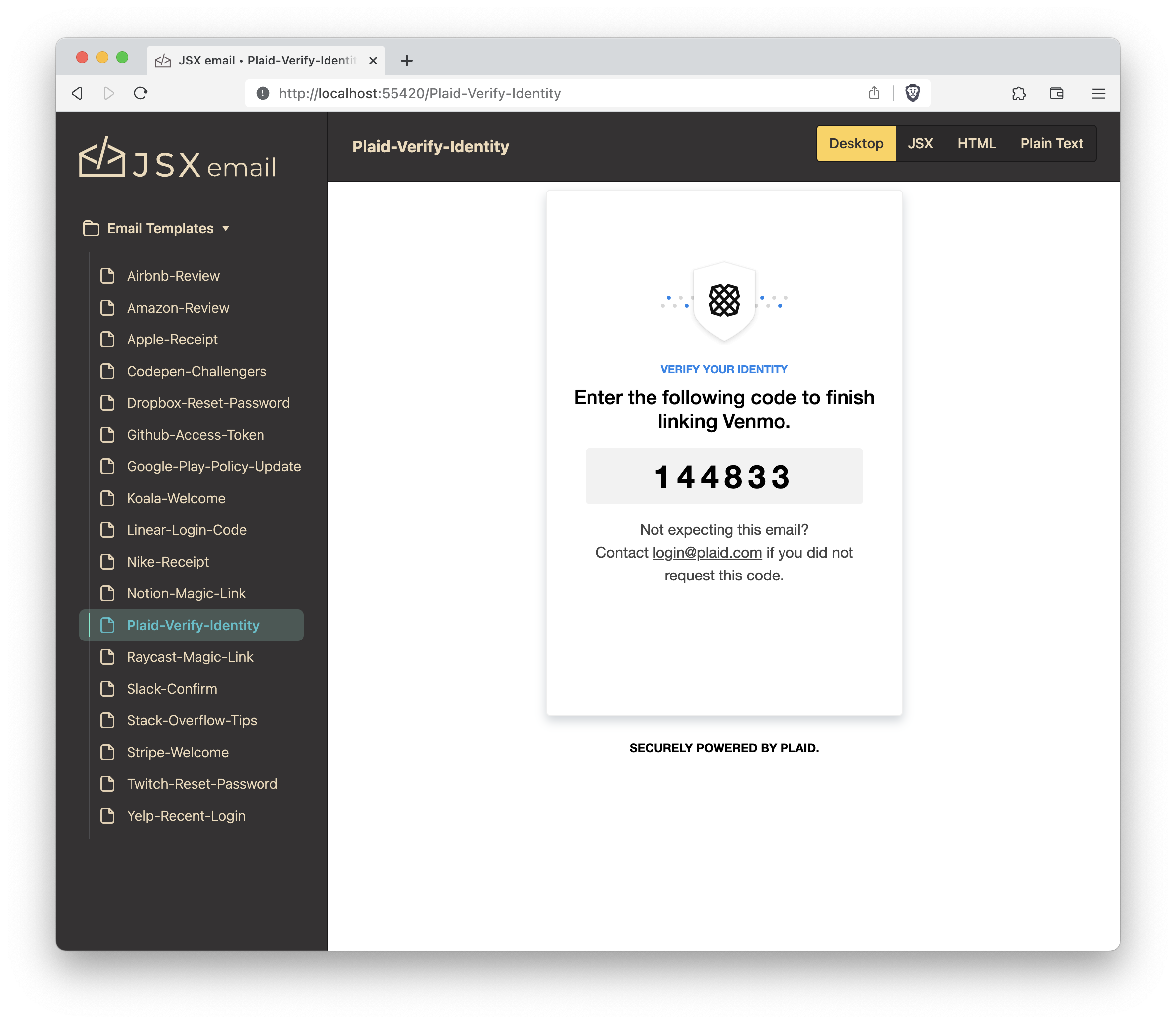
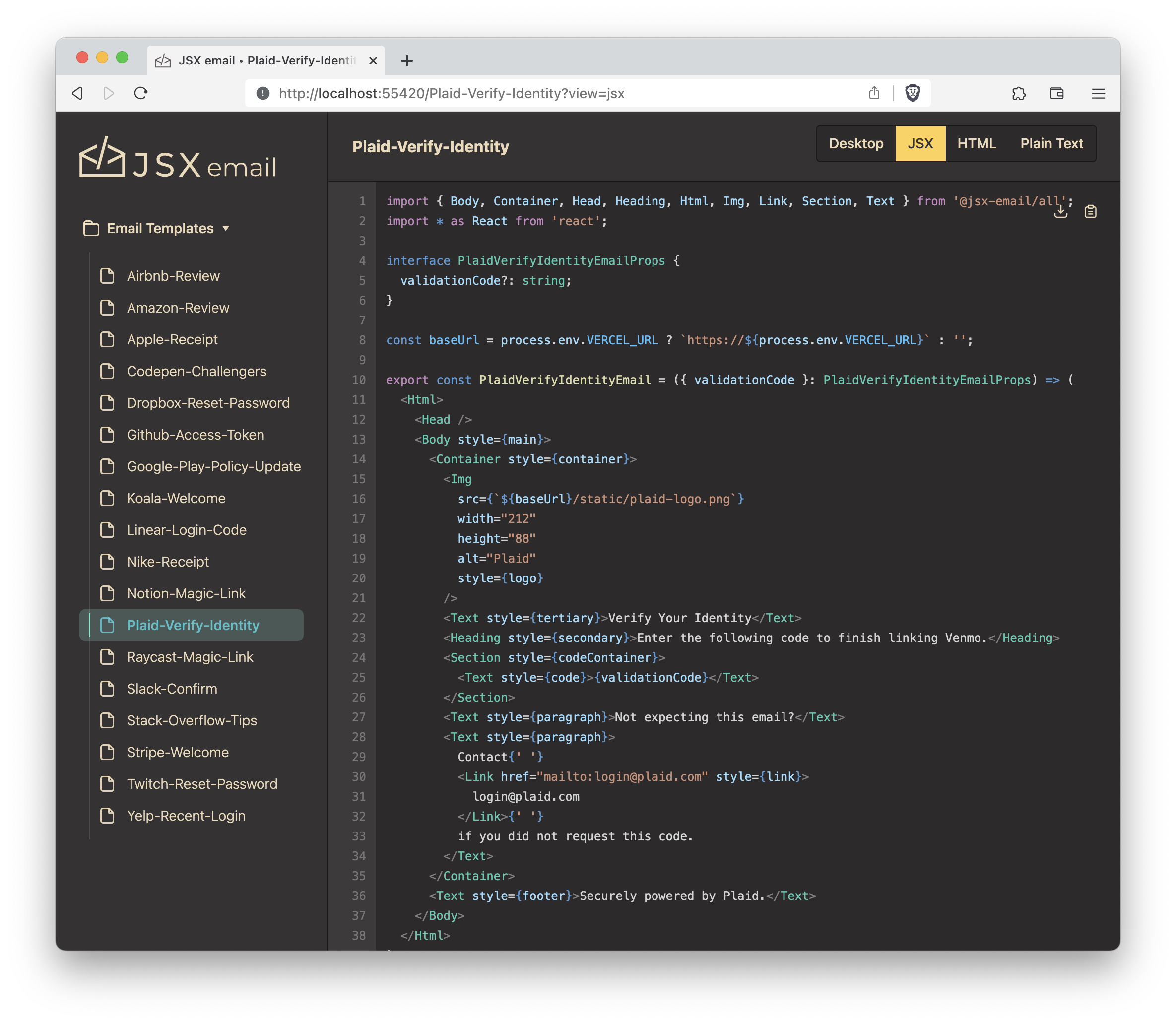
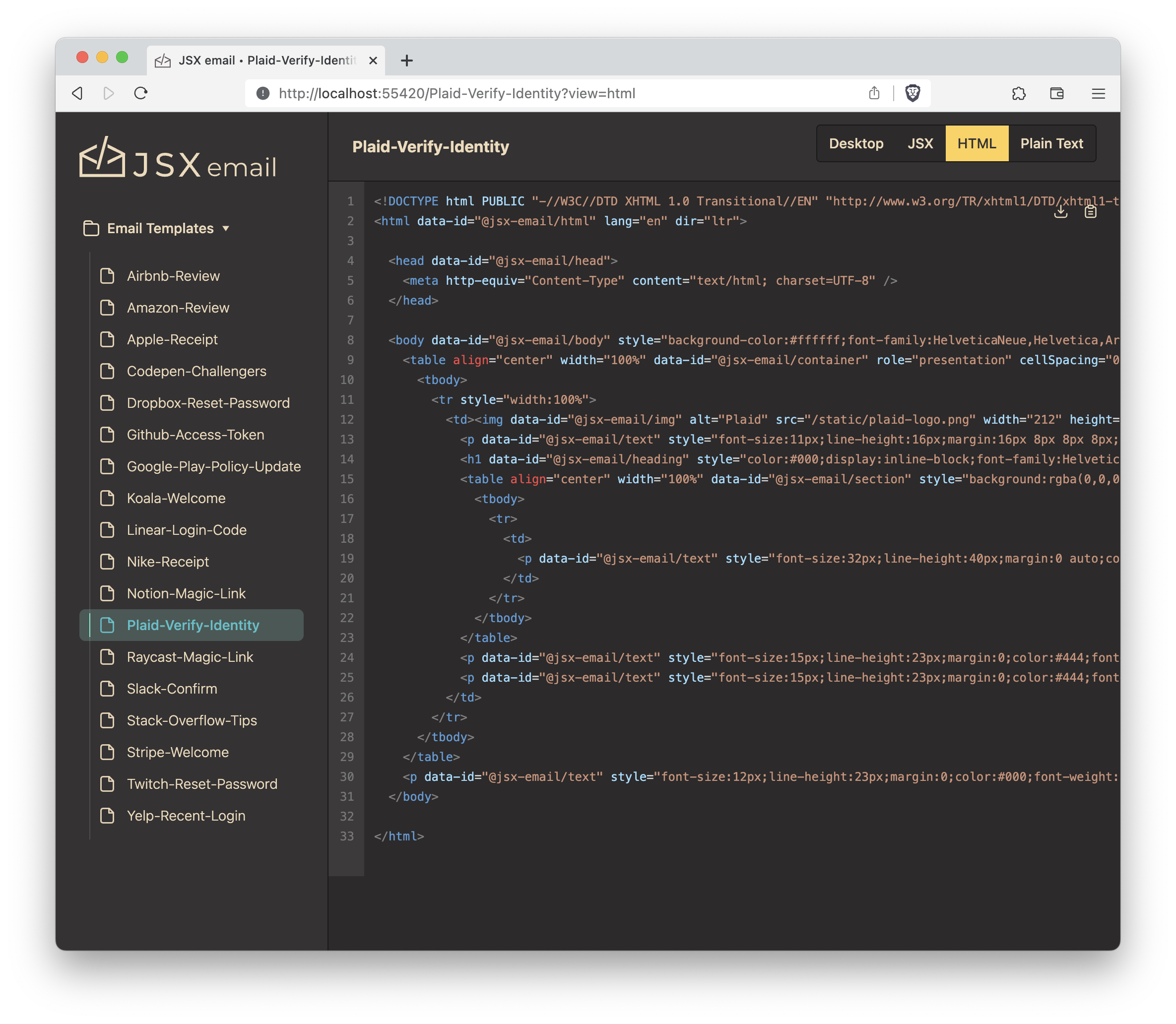
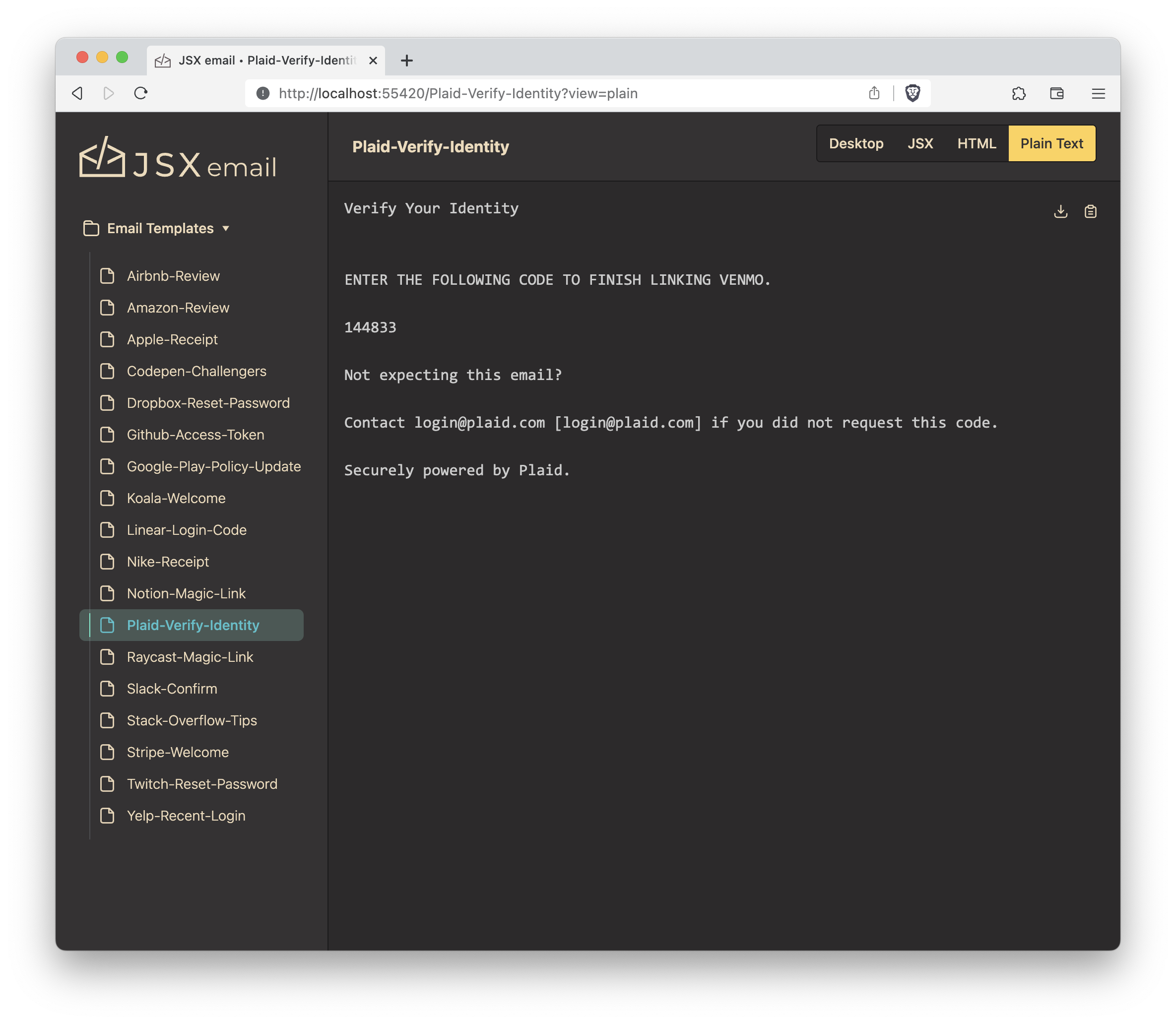
The Preview Tool will start up and open a new window in your browser, and you’ll be presented with a page that looks like:
Deploying Your Preview App
As part of the CLI, users have the ability to build their templates into a deployable preview app. The resulting app can be deployed anywhere, not just select service providers. To build templates into a deployable app, run:
$ email preview <templates-path> --build-path <build-path>where <build-path> is the path you want the build output files placed.